What are the EFT Points?

Can we please acknowledge how awkward it is to not understand something everyone around you seems to be an expert in?
Yes? Great!
If you’re in agreement that it is extremely awkward to nod along while praying no one asks you to speak up, then travel back in time with me to when I first learned EFT.
Read this blog post to read the full story of how I found EFT.
But for the purpose of this post, I’ll give you the TLDR: I found EFT on Instagram, had a full body “yes”, and jumped straight into a multi-weekend workshop to learn everything I could.
And that first day? I knew nothing. I had never tapped. Had a lot of information flowing into my mind while learning the first things about what EFT is. And I had no idea where to even tap.
So, I kept myself on mute and hoped I wouldn’t have to speak up because I was so scared of being found out as a complete beginner!
I don’t want you to feel that way about EFT.
Whether you are brand new to EFT or have done some tapping, I want you to know exactly what points to tap, what to say, and what it means!
Because if the questions of “wait what am I supposed to be doing” or “do I tap on my forehead?” are blocking you from feeling the relief that EFT brings, then I have work to do!
In this blog post, I’m breaking down the EFT points, sharing an example of what EFT sounds like in a basic EFT round, and what each point is connected to.
You don’t need to know every single thing about EFT or about what the points mean, but if you want to feed that inner curiosity by learning a bit more about the EFT points, then this is the blog post for you!
Let’s do a quick refresher:
What is EFT Tapping?
EFT stands for Emotional Freedom Techniques — and it’s often referred to as tapping (cute!).
EFT is a self-soothing technique that reduces cortisol levels in the body by sending “I’m not in danger” signals to your brain and nervous system.
It’s referred to as tapping because you are tapping on different pressure points found along meridians in the body.
Read my full explanation of what EFT is.
Now that we’re on the same page of what EFT Tapping even is, let’s get into what are the EFT points to tap on.
What are the EFT Points?
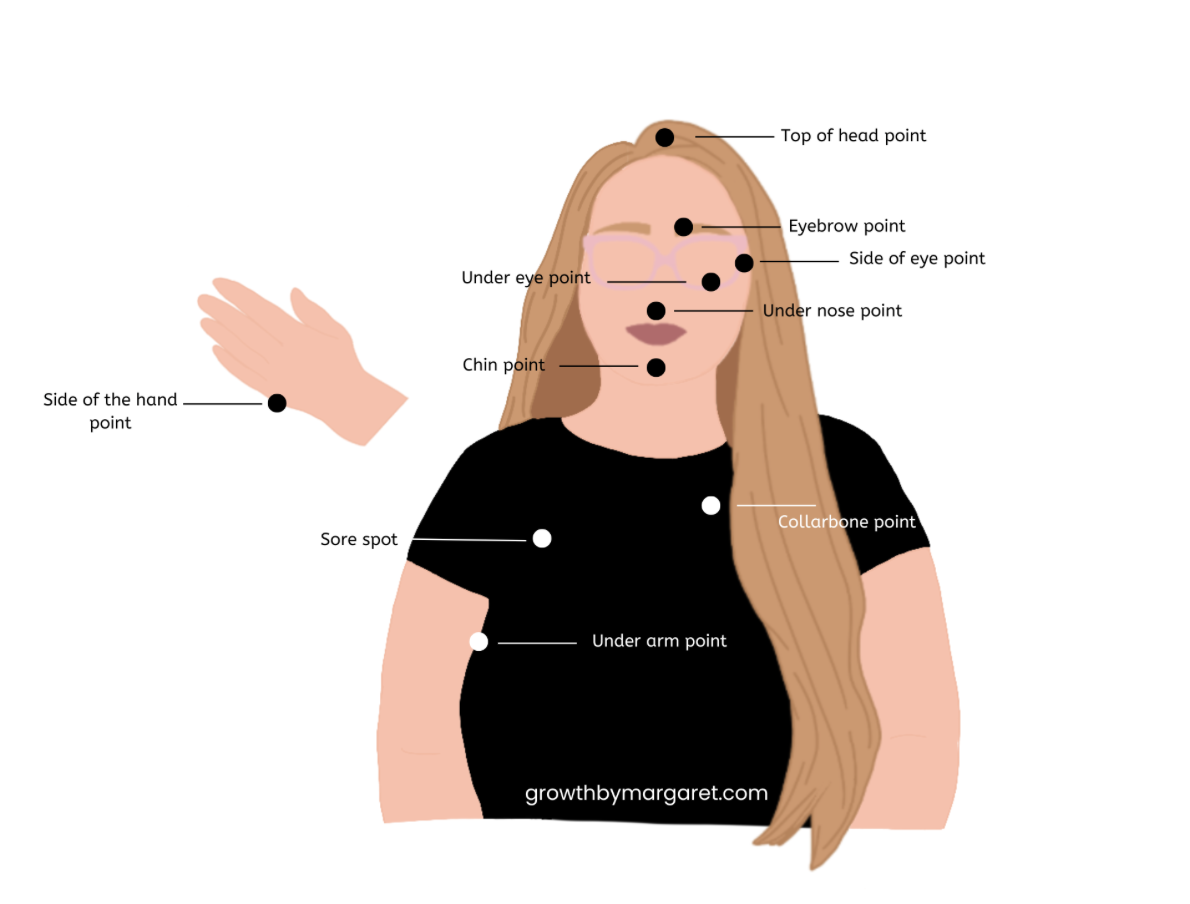
In this blog post and most EFT practices, there are nine main EFT points. BUT that doesn’t mean these points are the only ones we can use.
In my EFT sessions, I may guide you to add another EFT point to our round depending on what we’re working on or if you need a little more space with just feeling it.
All EFT points are along meridians. In Traditional Chinese Medicine, meridians are energy pathways in our bodies where our energy moves through the body. And the specific points along the meridians act as little exit ramps off of the energy pathways – allowing you to release emotion, lower cortisol, or let go of unsupportive energy.
Meridians are associated with center organs and emotions – which means the EFT points also have those associations which can give you insight into your pain and what you may need support with.
I’m going to share exactly where to find the EFT point on your body. And the associated meridian and emotions of the points.
Let’s talk about the main nine points we use while tapping!
SIDE OF THE HAND
How to find it: Find the fleshy part of your hand in-between your pinky finger and wrist.
Associated meridian/organ: Small intestine
Associated emotions: Lost, self-acceptance, lack of joy
TOP OF THE HEAD
How to find it: Find the middle of your head – aligned with the points of your ears and the middle of your face
Associated meridian/organ: Governing Vessel
Associated emotions: Embarrassment, inner critic, lack of courage
EYEBROW
How to find it: Find right where your eyebrow starts near your nose.
Associated meridian/organ: Bladder
Associated emotions: Shock, stuck, limiting beliefs, frustration
SIDE OF EYE
How to find it: Find the ridge of bone directly next to your eye – on the outside of the face.
Associated meridian/organ: Gallbladder
Associated emotions: Fear, negativity, indecision, self-doubt
UNDER EYE
How to find it: Find the ridge of bone directly under your eye – in the middle, under your pupil if you are looking straight ahead
Associated meridian/organ: Stomach
Associated emotions: Anxiety, stress, overwhelm, despair, safety, peace
UNDER NOSE
How to find it: Find in-between your nose and mouth – the ridge in the center
Associated meridian/organ: Governing Vessel
Associated emotions: Embarrassment, inner critic, lack of courage
CHIN
How to find it: Find below your mouth – before the end of your face
Associated meridian/organ: Conception Vessel
Associated emotions: Confusion, uncertainty
COLLARBONE
How to find it: Find the middle in-between section of your collarbones – move slightly underneath the bone and move towards the outside of your chest by about three inches
Associated meridian/organ: Kidney
Associated emotions: Anxiety, fear, emotional tension, dread, grounding
UNDER ARM
How to find it: Find underneath your arm – along your ribs – about four inches below your armpit
Associated meridian/organ: Spleen
Associated emotions: Insecurity, people pleasing, self-esteem, confidence
How do you tap on these points?
Past Margaret had these questions so maybe you do too. I’m going to give you the details ↓
“Do I tap with one finger or…?”
One or two fingers is usually most comfortable! But you can use more if that feels natural to you.
With two fingers – you’re more likely to make sure you’re truly tapping on the point.
“What side do I tap?”
Either! You can tap on just the right side, just the left side, or both sides (at the same time or with an alternating rhythm – left right left right).
Why? The meridians are parallel which means so are the points!
“How hard am I supposed to tap?”
Tap with enough pressure that you feel it – but don’t slam into yourself.
Sometimes you may naturally put more or less pressure on a point. So, check in with yourself to make sure it feels comfortable
“Wait, how long should I tap on each point?”
I suggest at least one breath or long enough to say your set up statement or reminder phrase! Your pace may change depending on the topic – so if you ever feel like you need it, slow down the tapping (stay on the point longer) or speed it up (move onto the next point slightly quicker).
“Do I have to say this out loud?”
Nope! You can say things out loud or in your mind. Whichever is going to help you stay focused – or what best fits where you are while you’re tapping.
“What if I forget a point?”
That’s okay! The reason we use all of these points is because the studies done around EFT use the full sequence. But each point sends the same “I’m okay” signal to your body so missing one isn’t a big deal.
Pick it up on the next round, find an alternative point, or keep tapping on the points you do remember.
“Um what does it mean if a point feels sore?”
If a point feels a bit sore or tender, this can signal what meridian may need extra support or what emotions you may want to explore further.
But if a point is ever super sore – like hurts to even touch lightly – skip the point for that day!
“It’s hard for me to reach a point – can I skip it?”
Yes! Some of my clients struggle to reach the Under Arm point due to mobility limitations so we skip it. Sometimes I’ll suggest an alternative point – or skip all together.
“Do I just tap the whole time?”
Nope! You want to give yourself a pause to check-in and readjust your phrasing. So, go through all EFT points with the set up statements and reminder phrases (explained below!) then pause.
Rest your hands somewhere comfortable and notice how you’re feeling in comparison to the start of the EFT round.
When you’re ready to start tapping again, start back on the side of the hand.
What do you say on the EFT Points?
Okay, maybe there is something more awkward than pretending you know what’s going on and hoping you won’t have to say anything – when you actually do have to speak up and you have no idea what to say.
If "I don't know what to say when I’m tapping” is what’s blocking you, let’s solve that!
For the side of the hand – you’re going to say something called a Set Up Statement. And you’ll say it three times.
The Set Up Statement formula: Addressing what you feel + a reframe
Examples Set Up Statements:
Even though I feel a lump in my throat thinking of the text I saw on his phone, I deeply and completely love and accept myself
Even though I saw that text and I feel sadness, I have compassion for myself and how I feel
Even though I’m feeling sad thinking of the text and there’s a lump in my throat, right here and now I’m okay
Notice how the reframe changes? As an EFT practitioner who deeply values being honest, I’m not going to force you into a reframe that doesn’t feel true – that completely goes against what EFT is about.
So, you can use the classic reframe: I deeply and completely love and accept myself
Or you can choose a different reframe that feels true to say.
Learn even more about why we use reframes in EFT and reframe alternatives in this blog post.
For the remainder of the points (top of head through under arm) – you’re going to say something called a Reminder Phrase. And you’ll say it once per point.
The Reminder Phrase formula: anything that keeps you focused on the trigger and your feeling about it
Example Reminder Phrases:
The lump in my throat
Seeing that text on the his phone
His phone with the text
Lump in my throat
Sad
The text on his phone
Sadness in my throat
Customize it to what you’re working on – and there you are using EFT!
Looking for a guided one-on-one EFT Tapping experience? Learn more about my EFT sessions!
Liked this post? Then you’ll love my weekly newsletter.
